
Comprehensive Guide: Upgrading PE Wax Quality via Short-Path Molecular Distillation (Purification, Decolorization & Fractionation)
Introduction: The Quality Bottlenecks in Industrial Polyethylene Wax
Polyethylene Wax (PE Wax) is a low molecular weight polymer wax that has multiple functions in polymer processing, printing ink, coating, masterbatch, and the hot melt adhesive industry. Typically having a molecular weight in the range of 1,000-4,000 g/mol, PE wax is used as an external/internal lubricant, release agent, and a pigment dispersant and may also improve surface gloss.
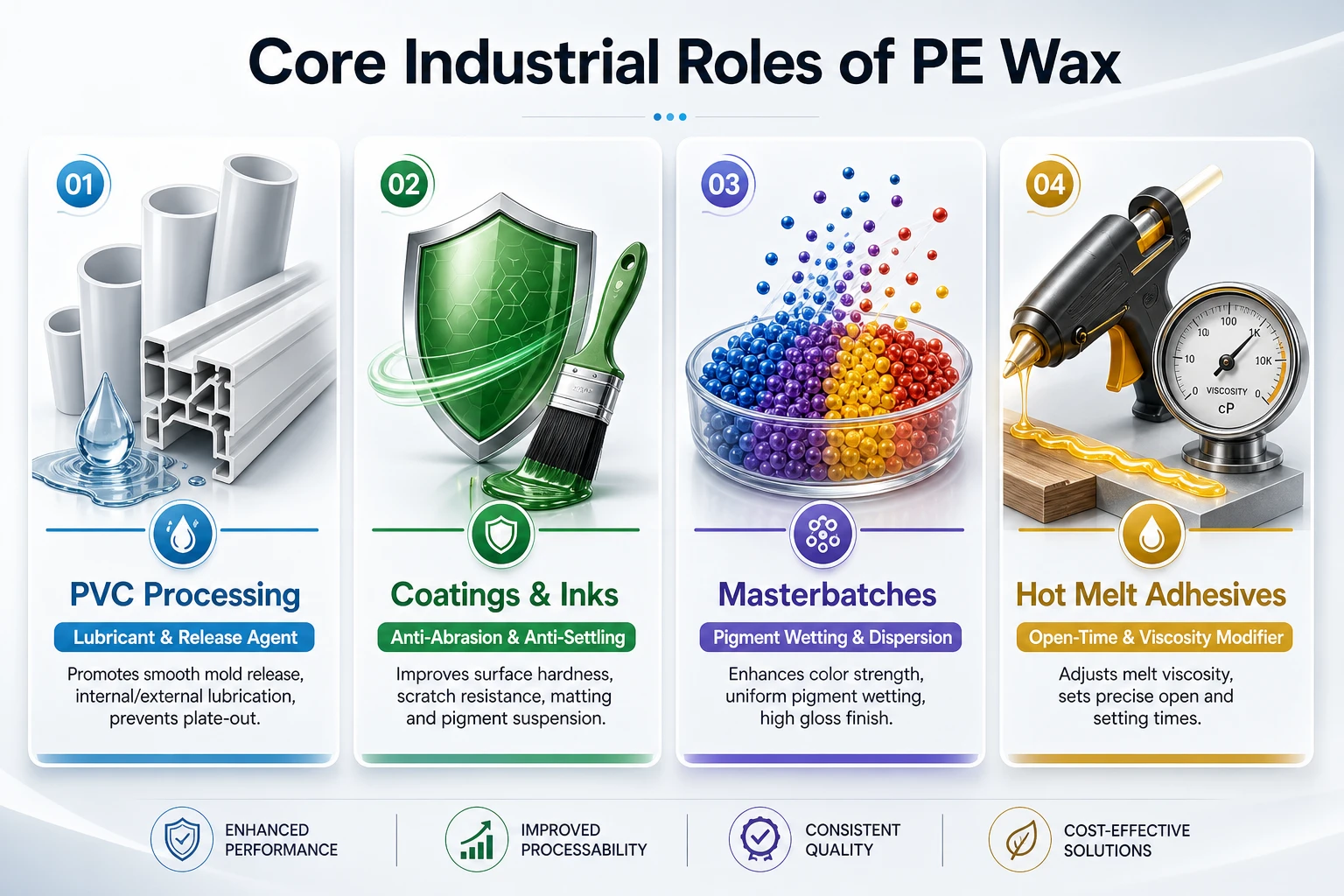
The Inherent Challenge of Raw PE Wax Feedstock
High-pressure ethylene polymerization or the thermal cracking (depolymerization) of high-density polyethylene (HDPE) produces PE Wax in its unrefined form. Raw PE Wax bears the following performance bottlenecks:
- Wide Molecular Weight Distribution (MWD) & Volatile Light Ends: Residual low-boiling oligomers (C10−C20) cause low flash points, foul odor, severe smoking during extrusion, and notorious “plate-out” on calender rolls and extruder dies.
- Thermal Yellowing & Chromophore Impurities: Uncontrolled thermal cracking leaves oxidized fragments, metal catalyst residues, and conjugated unsaturated bonds that impart a yellowish or brownish hue to the wax.
- Inconsistent Melt Viscosity and Drop Point: Wide polydispersity impairs lubrication consistency, resulting in unpredictable fusion behavior in PVC processing.
Why Conventional Distillation Fails
Atmospheric or conventional vacuum fractional distillation columns are not very effective for PE wax. With melting points between 100°C and 140°C (212°F and 284°F), and high melt viscosities, PE wax degrades to a char (carbon) and coke before reaching the equilibrium boiling point.
To overcome these structural limitations, Short-Path Molecular Distillation (SPMD)—also known as wiped-film molecular distillation—has emerged as the definitive industrial gold standard for high-end PE wax purification and fractional upgrading.
Fundamental Principle: How Short-Path Molecular Distillation (SPMD) Works on PE Wax
Unlike conventional distillation governed by vapor-liquid equilibrium (VLE) boiling point differences, molecular distillation is a non-equilibrium physical separation process based on the difference in the mean free path (λ) of molecular motion.
Where kB is the Boltzmann constant, T is temperature, d is the molecular diameter, and P is system pressure.
Key Engineering Advantages of SPMD for PE Wax:
- Operating Vacuum of 0.001 – 0.1 mbar: By lowering the operating pressure to molecular-range vacuum levels, the boiling temperature of the volatile components of the charge decreases by 100°C to 180°C compared to ambient conditions, promoting faster removal of moisture and other volatiles.
- Minimal Distance Between Evaporator and Condenser: The distance between the heated evaporation surface and the built-in internal condenser is much less than the mean free path of light volatile molecules (≈20-50 mm≈20-50 mm), and therefore condensation happens instantly and there is no vapor back-mixing.
- Very Short Thermal Residence Time (<10-30 seconds <10-30 seconds): Molten wax is rapidly spread to an ultra-thin (0.1-0.5 mm0.1-0.5 mm) and turbulent liquid film which prevents thermal hot spots and localized coking. This promotes polymer chain scission and breaks down polymer chains.
The 3-Step Purification Matrix: Light-Ends Removal, Decolorization & Fractionation
Industrial short-path molecular distillation delivers a comprehensive 3-in-1 upgrading solution for PE wax manufacturers and compounding converters:
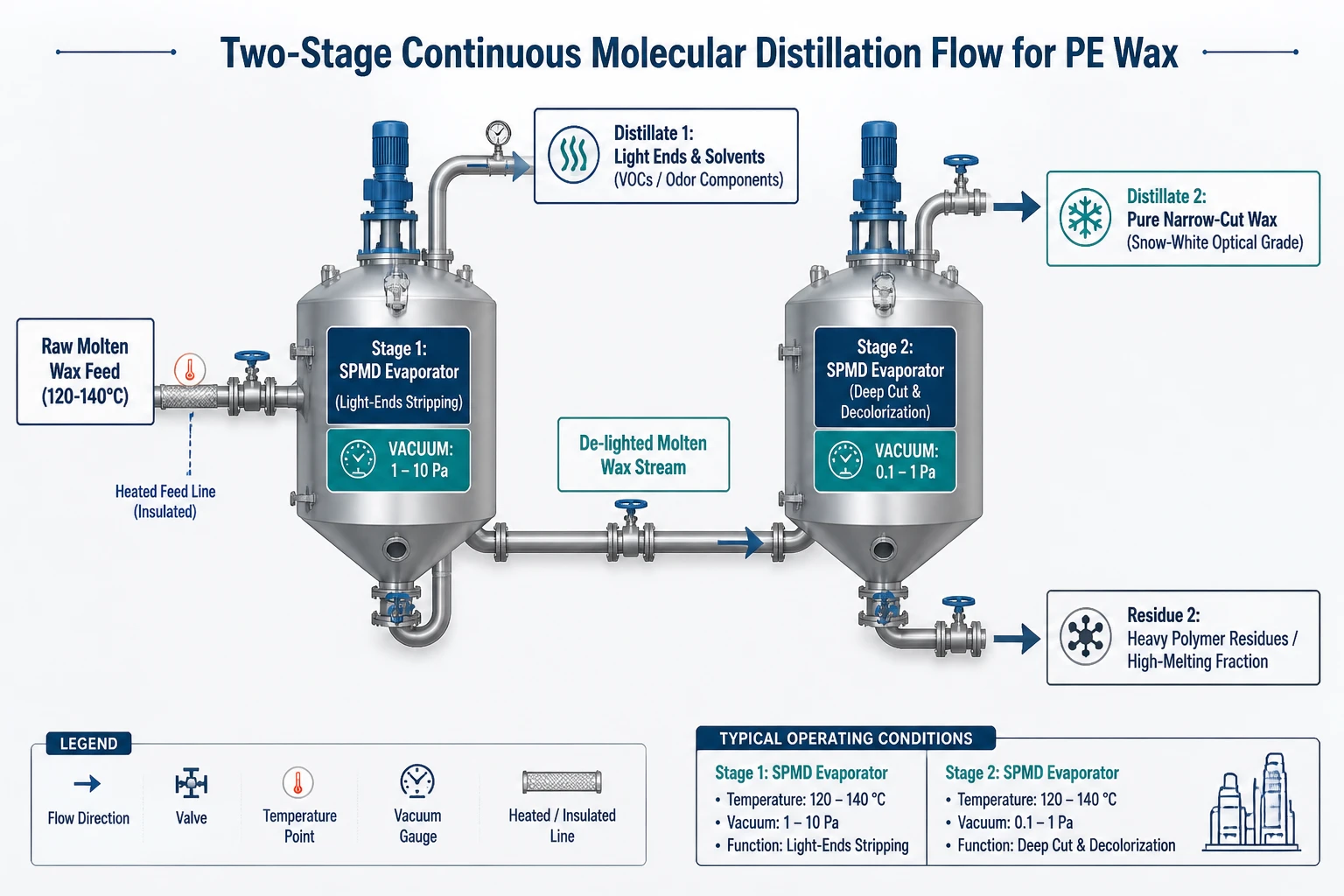
Step 1: Light-Ends & Volatiles Removal ( Deodorization)
Raw PE wax contains low molecular weight oligomers and byproducts of degradation.
- Mechanism: In the first stage, volatile compounds are removed under low to medium vacuum (1 -10 Pa). Low molecular weight PE fractions evaporate first and condense on the inner surface of the condenser.
- Outcome:
- VOC content is reduced by >95%.
- Flash point is increased by 20−40∘C.
- Eliminates pungent odor and smoking during downstream masterbatch extrusion and PVC calendering.
Step 2: Decolorization & High-Temperature Clarification
A wide range of polymer applications calls for a very tight window of properties, e.g., melt viscosity and crystallization temperature.
- Mechanism: Residual heavy ends are removed, and a low-viscosity distillate, which is a good internal lubricant, is obtained.
- Outcome: The high carbon number heavy ends are removed, and a high melting point high drop point wax (>125°C>125°C) is obtained.
Step 3: Precise Molecular Cut & Viscosity Fractionation (Narrow Cut Fractionation)
Different polymer applications demand strictly tailored melt viscosities and crystallizing drop points.
- Low-Viscosity, High-Flow Fractions: Long-chain branched heavy ends are separated out in the residue, leaving a low-viscosity, high-slip lubricant distillate with exceptional internal lubrication characteristics.
- High-Melting-Point Specialized Fractions: When high-temperature resistance is required (e.g., for hot-melt adhesives or cable insulation), the high-carbon-number heavy phase is concentrated and harvested as a premium high-drop-point wax (>125∘C).
Industrial System Configurations: Single-Stage vs. Two-Stage Tandem Distillation
Equipment configuration depends on crude wax quality and the required target specifications. For pilot trials, recipe formulation, and industrial scale-up, systems such as the MDS-10CE Dual-Stage Molecular Distillation System—with an evaporation area of 0.1 m² per stage and 0.4 m² internal dual-coil condensers—represent a benchmark continuous-processing platform.
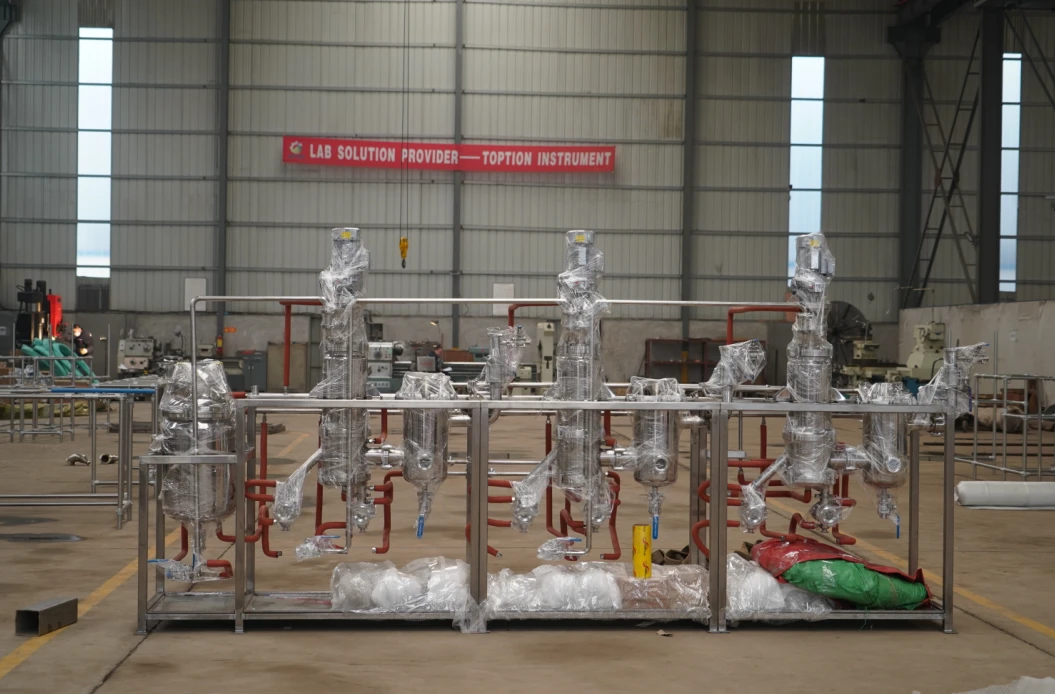
Process Equipment Comparison & Real Equipment Specifications
| Technical Evaluation Metric | Single-Stage SPMD Unit | Two-Stage Tandem SPMD Plant (e.g., MDS-10CE Platform) | Hybrid Thin-Film + SPMD Industrial Plant |
|---|---|---|---|
| Primary Process Objective | Light-ends stripping, basic degassing, odor reduction | Simultaneous de-light, optical decolorization & narrow MWD cut | High-throughput solvent stripping followed by deep polymer fractionation |
| Evaporation & Condensing Area | 0.1−0.5 m2 Single Evaporator | Dual 0.1 m2 Evaporators (SUS316L) + Dual 0.4 m2 Internal Condensers | Pre-evaporator (0.5−2.0 m2) + Secondary SPMD (0.5−5.0 m2) |
| Feed Throughput / Flow Rate | 3−15 L/h (Pilot) / Scalable | 3−15 L/h (Continuous 0.1 m2 Skid) / Scalable to >500 kg/h | 50−1,000+ kg/h (Commercial Bulk) |
| Operating Vacuum Level | 1−10 Pa (0.01−0.1 mbar) | Stage 1: 1−10 Pa (0.01−0.1 mbar) Stage 2: <1 Pa (<0.01 mbar, no-load ultimate <1 Pa) |
Pre-stage: 100−500 Pa Main stage: <0.5 Pa |
| Vacuum Pump Train | Rotary Vane + Mechanical Roots | Rotary Vane + High-Vacuum Molecular / Diffusion Pump Group | Multi-Stage Roots + Diffusion Pump Train |
| Cold Trap Protection | Single Chilled Condenser Coil | Dual Cold Traps per Stage: Primary Low-Temp Refrigerated Trap + Secondary Liquid Nitrogen (LN2) / Dry Ice Trap | High-Capacity Dual Cryogenic Traps |
| Material of Construction (MOC) | SUS304 / SUS316L | Wetted contact parts: SUS316L (S31603) Jacket & Structural parts: SUS304 |
Sanitary SUS316L / Hastelloy Options |
| Wiper Drive & Rotor Speed | Mechanical Seal (100–300 RPM) | Hermetic Magnetic Drive Coupling, VFD speed adjustable up to 460 r/min | Heavy-duty Magnetic Drive (Adjustable) |
| Continuous Discharge System | Manual Receiver Flasks / Pump | 4.5 CC Precision Heated Gear Pumps with Adjustable Spring-Loaded Pressure Check Valves | Jacketed Magnetic Gear Pumps / Canned Pumps |
| Polydispersity Index (Mw/Mn) | 1.8−2.2 (Moderate) | 1.2−1.5 (Precision Narrow Cut) | Customized Narrow MWD Distributions |
Value Proposition: End-Product Performance Enhancements
Short-path molecular distillation to purify PE wax gives numerous competitive advantages in several industries:
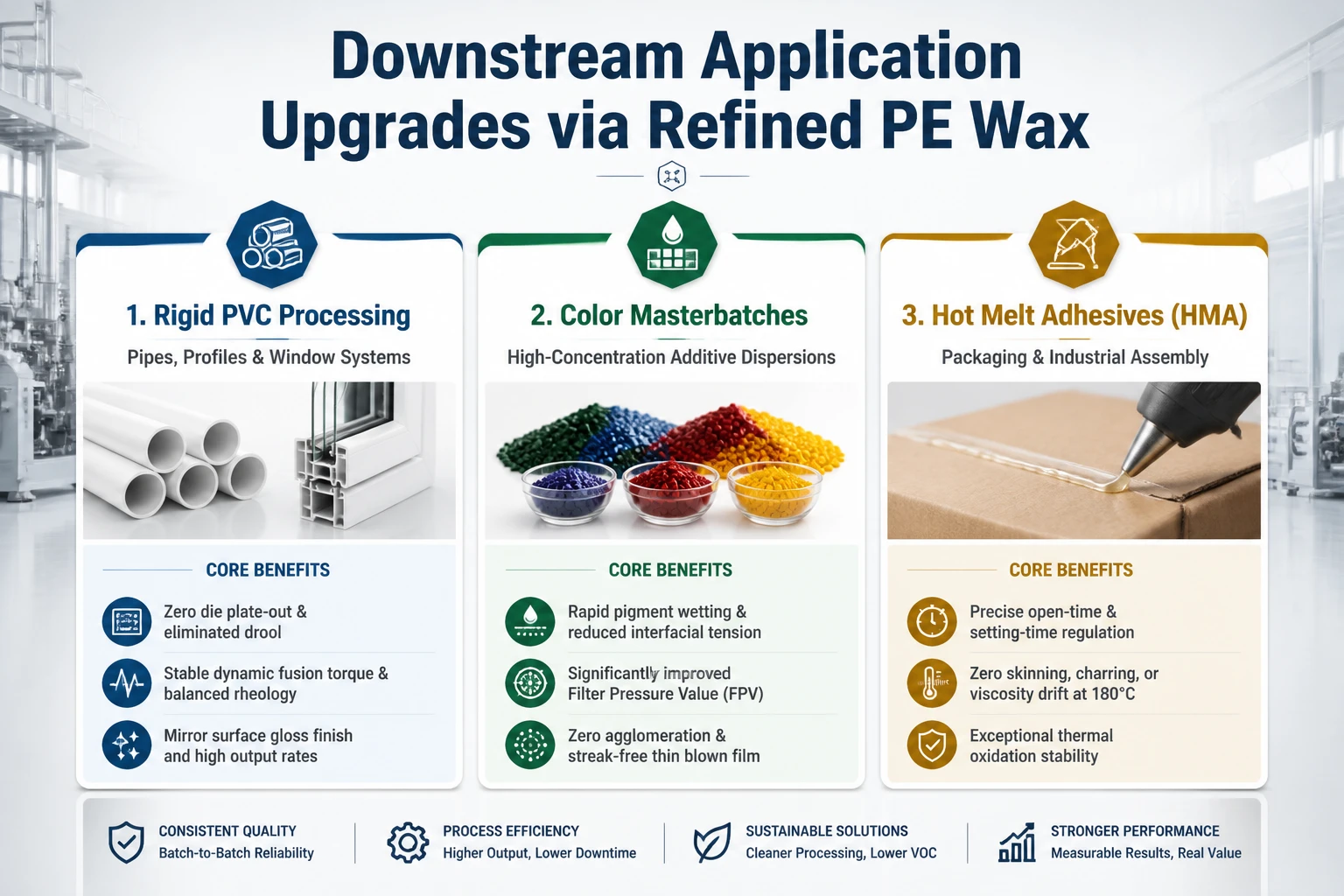
Rigid PVC Pipes, Profiles & Foam Boards
- Zero Die Buildup: Low-molecular weight tail volatiles cause die drool, plate out and surface pitting.
- Balanced Rheology: Without these, rheology is well balanced, resulting in a more predictable dynamic fusion time and a lower torque requirement during twin screw extrusion. It also yields a better gloss on the outer wall of the extrusion.
High-Concentration Color & Additive Masterbatches
- Superior Pigment Wetting: Narrow-cut PE wax lowers the interfacial surface tension between polymer carriers (PE/PP) and inorganic pigments (TiO2, Carbon Black), boosting color yield and filterability.
- No Dispersion Agglomeration: Uniform melt viscosity ensures streak-free blowing for ultra-thin blown films.
Hot-Melt Adhesives (HMA) & Road Marking Paints
- Controlled Open Time: Precise crystallization kinetics ensure fast setting times and sharp softening points.
- Thermal Aging Stability: Decolorized, saturated linear wax chains have no skinning or charring and give better thermal stability during long term heat exposure (180ºC).
Key Engineering & Operational Best Practices for PE Wax Distillation Plants
Continuous Thermal Tracing (Zero-Cold-Spot Design)
- PE wax solidifies below 100 °C. To ensure no cold spots and solidification, full-jacket heating is provided on all 15 L feed vessels, DN15 thermal ball valves, interstage transfer lines, distillation barrels, collection tanks and discharge lines. Operating temperatures are set between 120 and 150 °C using hot-oil circulation.
Hermetic Magnetic Drive and Wiper Rotor Assembly
- To minimize air ingress into the high-vacuum system at elevated temperatures, hermetic magnetic-drive couplings are used. Evaporator rotors are driven by 0.37 kW variable-frequency motors. Stepless speed control is provided up to 460 r/min. Continuously forming an extremely thin, turbulent, liquid film on the surface of the evaporator wall is accomplished by precision wiper blades.
Deep-Vacuum Pumping Train and Cold-Trap Protection
- A combination of rotary-vane pumps and either high-vacuum molecular or diffusion pumps are provided. The system is specified to achieve a leak rate of ≤2 Pa/min and to attain an ultimate pressure of 1 Pa (0.01 mbar) absolute.
- Each stage has two cold traps in series. The first, primary, cold trap, is a glycol-coil type, which is refrigerated to −20 °C. The second, or the series trap, is liquid-nitrogen or dry-ice type. The cold traps are provided to capture volatile light ends.
Continuous Molten-Wax Discharge and Backpressure Control
- Heated 4.5 cc stainless-steel, rotary gear pumps, provide continuous discharge under negative pressure. Backpressure is controlled using adjustable, spring-loaded check valves and FKM/PTFE seals. The estimated flow-rate is 3-15 L/h per 0.1 m² skid.
Conclusion & Turnkey Engineering Solutions
Short-path molecular distillation represents the most technologically advanced and economically viable route to transform low-value, unrefined PE wax into premium, high-margin functional polymers. By simultaneously executing light-ends degassing, deep decolorization, and precise molecular weight fractionation, manufacturers can access lucrative high-end export markets in masterbatches, PVC lubrication, coatings, and adhesives.
Improve Your Polymer Wax Production Line
Are you trying to remove odor, or improve the whiteness and/or reduce the melt index of PE wax grades?
- Do you want to produce customized PE wax grades? Are you interested in a molecular distillation system to perform these tasks?
- Contact our process engineering team to discuss a customized system or schedule a pilot-scale feasibility trial.